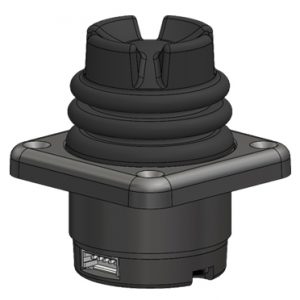
 Does TMR eliminate the centering concerns of Hall effect?
Engineers who specify hall effect joysticks often ask whether TMR changes the fundamentals of centering accuracy under real-world loads and lifecycles.
In comparative evaluations, hall effect joysticks can perform well, but TMR joystick sensors frequently tighten symmetry and reduce tiny residual offsets around center.
Designers trying to curb small spring-stack asymmetries in hall effect joysticks sometimes pursue return-to-center stability improvements at the sensor level, and that’s where TMR can help; to see how different vendors implement this, learn more.
For applications that log long duty cycles, hall effect joysticks demand consistent magnetic fields, rigid gimbals, and mechanically stable magnets to keep zero locked in.
When space is constrained yet precision matters, hall effect joysticks can still be a good fit if the mechanical centering system is robust and thermally balanced, and for selection checklists, visit the site.
Ultimately, hall effect joysticks deliver reliable service when mechanical, magnetic, and computational elements are engineered as a single system.
TMR’s advantage shows when hall effect joysticks are pushed to environmental extremes, because TMR can suppress Hall effect joystick centering drift through higher bridge sensitivity and better signal-to-noise, and if you need application notes, read more.
A well-designed controller couples hall effect joysticks with magnetic angle sensor calibration so that the system normalizes gains, trims symmetry, and linearizes the center window under different payloads.
In mobile robotics, hall effect joysticks gain predictable repeatability when paired with zero-position offset compensation that tracks thermal and mechanical hysteresis, and for implementation patterns, visit the site.
Harsh shock and vibration can nudge magnets sideways, so hall effect joysticks must be guarded against cross-axis sensitivity in joysticks with careful shielding and axial constraints, and for mitigation checklists, learn more.
Seasonal temperature swings alter magnet flux density, so hall effect joysticks benefit from models that anticipate temperature drift of Hall sensors and apply closed-loop corrections based on field references.
For safety-rated controls, hall effect joysticks paired with contactless joystick accuracy architectures can achieve redundant channels with high common-mode rejection, and for certification pointers, read more.
Tight packaging can skew field geometry; therefore, hall effect joysticks should be validated for magnet alignment and linearity using shimming or magnet-grade selection to minimize angular error.
During platform migrations, teams compare hall effect joysticks across potentiometer vs Hall vs TMR tradeoffs, weighing cost, lifetime, and EMC behavior for each topology, and for a side-by-side worksheet, visit the site.
In human–machine interfaces, hall effect joysticks can show imperceptible offset creep when seals or bearings age, but robust TMR front-ends may cut the detection threshold of drift, and to check test methods, learn more.
When developers chase micro-deadzone consistency, hall effect joysticks reveal the importance of gimbal symmetry, spring choice, and the firmware filter stack that governs how quickly the center re-latches after release.
For retrofit programs, hall effect joysticks can be drop-in replacements if the magnetic stack height and neutral angle match, and validation should include cold-start and soak cycles, then read more.
Gaming-grade mechatronics push hall effect joysticks to low-latency performance where unfiltered noise can masquerade as bias, so TMR’s higher output often allows gentler filtering, preserving feel, and to browse benchmarks, visit the site.
Industrial cranes and AGVs rely on hall effect joysticks with resilient yokes that prevent torsional bias, and TMR can further shrink the center window without demanding ultra-stiff hardware, so teams can learn more.
Across safety cases, hall effect joysticks should be proven under load-path imbalances, since asymmetric operator force can fake a small center shift that smarter sensing chains can distinguish from true offset.
Fleet maintainers prefer hall effect joysticks with field-calibration modes that periodically re-baseline neutral with minimal downtime, and concise SOPs help avoid compounding small mechanical variances, so read more.
For marine consoles, moisture and salt fog threaten bearings; properly sealed hall effect joysticks keep friction constant, which pairs well with TMR’s low-noise output to stabilize tiny neutral bands, and for enclosure tips, visit the site.
User experience teams note that hall effect joysticks feel “honest” when the return arc is smooth and the neutral bite point is sharp; TMR’s symmetry can make that tactile cue more repeatable across units, so learn more.
Ultimately, the question is not whether hall effect joysticks can center well, but how much design margin you want in offset immunity when friction, temperature, and wear add up across years of service.
If you’re assessing next-gen upgrades to hall effect joysticks, remember that TMR joystick sensors can reduce the sensor-side contribution to zero error while keeping integration steps familiar.
Teams that demand peak repeatability from hall effect joysticks will appreciate how return-to-center stability improves when the sensing chain is less susceptible to micro-variations in field strength, and to see case studies, read more.
Procurement leads comparing hall effect joysticks should specify tight neutral tolerance across temperature, shock, and vibration, then verify that calibration and mechanical design sustain that spec over life, and for RFP templates, visit the site.
From a risk perspective, hall effect joysticks remain viable and proven, yet TMR-based options offer additional headroom that can turn borderline centering budgets into robust, production-friendly solutions.
Operations teams deploying fleets of hall effect joysticks can minimize downtime with smart service intervals and quick verification routines that confirm neutral without opening enclosures.
In performance-critical motion systems, hall effect joysticks backed by disciplined magnetic design and TMR front-ends provide consistent neutral behavior that operators trust during long shifts.
Program managers selecting hall effect joysticks should run A/B pilots across environmental corners to quantify neutral scatter before freezing the BOM, and for planning checklists, learn more.